Every business owner hits the same fork in the road. You want more customers from Google, but your budget is limited. Do you pay for ads, or do you invest in ranking on your own?
That is the SEO vs PPC question, and it has no one-size-fits-all answer. SEO builds visibility you earn over time. PPC buys visibility the moment you pay. Each one solves a different problem.
In this guide, you will learn how both channels work, how they compare on cost, speed and trust, and how to pick the right mix for your business. We also share a simple budget framework you can use this week.
Quick Answer: What Is the Difference Between SEO and PPC?
| SEO vs PPC at a glance |
|---|
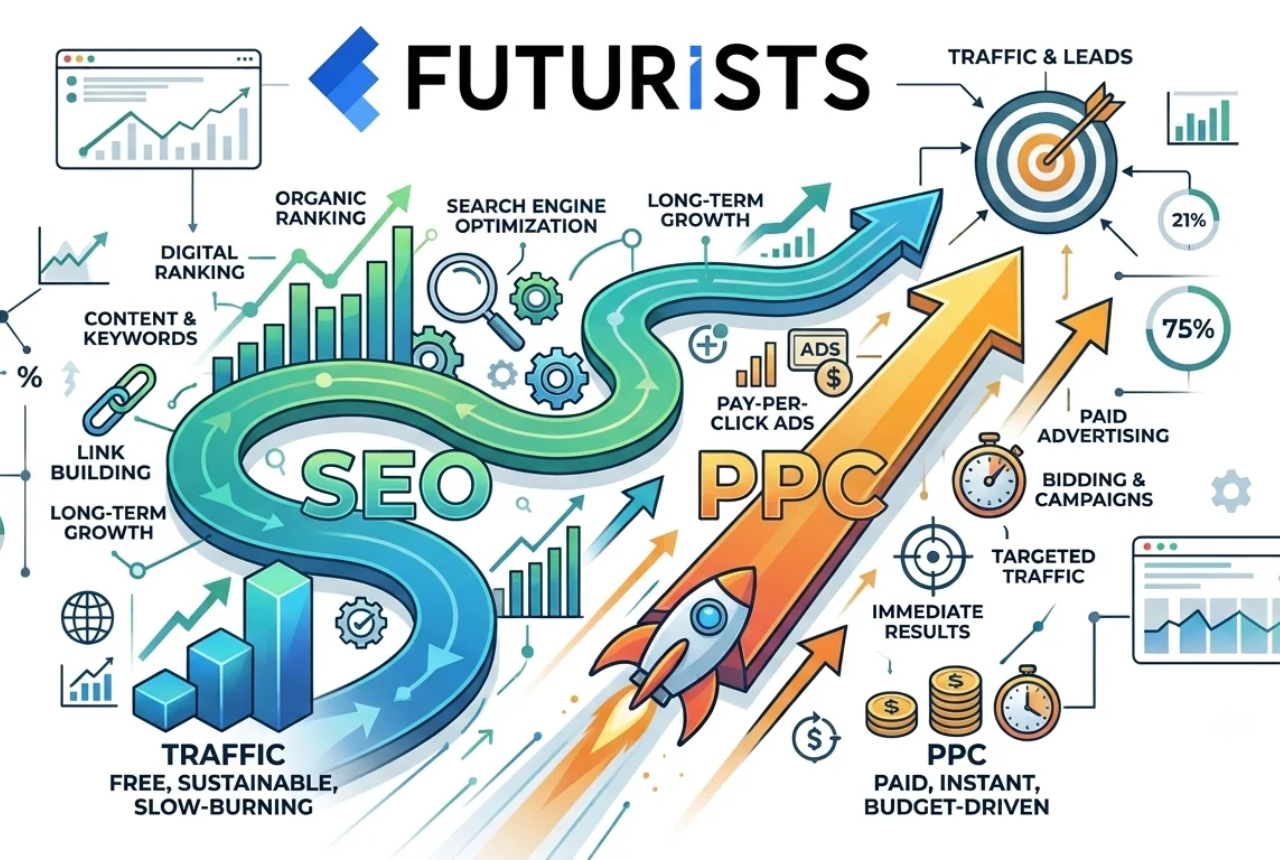
| SEO (Search Engine Optimization) earns free, organic rankings by improving your website and content, and usually takes months to build. PPC (Pay-Per-Click) places paid ads at the top of search results, delivers traffic within days, and stops the moment you stop paying. |
That one paragraph is the core of the debate. Now let us unpack it.
What Is SEO?
SEO is the practice of making your website easier for search engines to find, understand and trust. When someone searches for a service you offer, SEO helps your page appear in the natural (organic) results.
SEO work usually covers four areas:
- Technical health: fast loading, mobile friendly pages and clean site structure
- Content: helpful pages and blog posts that answer real questions
- Authority: links and mentions from other trusted websites
- Local signals: your Google Business Profile, reviews and consistent address details
Google itself publishes a free SEO Starter Guide that explains these basics, including how long results can take to show up. It is worth a read before you hire anyone.
What Is PPC?
PPC means you pay a platform each time someone clicks your ad. On Google, your ad can appear above the organic results for the keywords you choose. You set a budget, write the ad, pick the audience and send people to a landing page.
Two things make PPC powerful:
- Control. You choose the keywords, the location, the device and the time of day.
- Speed. A well-built campaign can bring visitors the same week it launches.
Cost per click is not just about who bids the most. Google also looks at ad relevance and landing page quality, which it summarises as Quality Score. A better, more relevant ad can win a higher spot for less money.
SEO vs PPC: 7 Key Differences
1. Speed to results
PPC wins here. Ads can drive clicks within days. SEO is a slow build. Most sites need several months of steady work before rankings move in a meaningful way.
2. Cost structure
SEO needs upfront investment in content, fixes and links, but a ranking page keeps working without a per-click fee. PPC charges you for every visit, forever. Stop the budget and the traffic stops too.
3. Long-term value
SEO behaves like an asset. A strong guide published today can bring leads for years. PPC behaves like rent. You get the space only while you pay.
4. Trust and credibility
Many searchers scroll past ads and click organic listings because they feel more earned. That does not make PPC weak. It simply means SEO often carries extra credibility, especially for high-trust purchases like healthcare, education and property.
5. Targeting and control
PPC gives sharper control. You can target a pin code, a device, a search phrase or a time slot. SEO is less precise. You influence who finds you, but you cannot dial it up or down overnight.
6. Measurement
Both are measurable, but PPC makes the math simple. You see spend, clicks and enquiries in one dashboard. SEO attribution is a little messier because traffic builds from many pages and many searches.
7. Risk and flexibility
PPC lets you test fast. You can change an offer in an hour. SEO is slower to change, and algorithm updates can shift rankings. On the other side, PPC costs can climb when competitors enter your market.
Pros and Cons at a Glance
SEO pros
- Compounding traffic over time
- Lower cost per lead once pages rank
- Builds brand trust and topical authority
SEO cons
- Slow start
- No guaranteed rankings
- Needs consistent content and upkeep
PPC pros
- Fast traffic and fast learning
- Precise targeting
- Easy to scale a winning offer
PPC cons
- Traffic stops when budget stops
- Costs can rise in competitive niches
- Weak landing pages waste money quickly
When PPC Is the Smarter Choice
Pick PPC first when time matters more than long-term savings. Typical examples:
- A new launch. A new clinic, showroom or housing project needs enquiries now, not in six months.
- Seasonal offers. Festival sales, admission windows and event dates have a fixed deadline.
- Testing a market. Ads reveal which keywords and offers convert before you commit to a long content plan.
- A thin website. If your site has few pages, ads can fill the gap while you build.
When SEO Is the Smarter Choice
Pick SEO first when you are playing the long game. Typical examples:
- Tight monthly budgets. Content you own keeps paying you back.
- Research-heavy buying. People comparing schools, doctors, builders or software read a lot before they call.
- Crowded paid markets. If ad costs are high, strong organic rankings protect your margin.
- Local services. A well-optimised Google Business Profile can bring a steady stream of nearby customers.
Why the Best Answer Is Often Both
Treating SEO and PPC as rivals is the real mistake. They feed each other.
- PPC data improves SEO. Ads show you which search terms actually turn into enquiries. Use those terms to plan your blog posts and service pages.
- SEO lowers PPC pressure. As organic rankings grow, you can trim ad spend on keywords you already win.
- Together they take more space. Showing up in both the ad slot and the organic results makes your brand look bigger and more established.
- Retargeting closes the loop. Visitors who found you through SEO can be reminded through ads, which brings back people who were not ready to act.
A Simple Budget Framework You Can Use
There is no magic ratio, but this starting point works for many small and mid-size businesses. Adjust it after the first 90 days.
| Your situation | Suggested lean |
|---|---|
| Brand new business, need leads now | Mostly PPC, with basic SEO foundations running in parallel |
| Established business, steady budget | Balanced mix, growing SEO share over time |
| Limited budget, long sales cycle | Mostly SEO, small PPC budget on your best-converting terms |
| Short-term event or offer | Almost all PPC for the campaign window |
Review the split every quarter. If a keyword brings enquiries from ads and you now rank organically for it, move part of that budget to a new keyword.
Common Mistakes to Avoid
- Judging SEO after four weeks. It needs time. Measure leading signals like impressions and ranking growth first.
- Sending ad traffic to your homepage. Use a focused landing page with one clear action.
- Ignoring mobile. Most local searches happen on phones. Slow or clumsy mobile pages waste both SEO and PPC effort.
- Skipping conversion tracking. If you cannot see which clicks became calls or forms, you cannot improve.
- Copying a competitor’s plan. Their goals, margins and sales cycle are not yours.
A Local Note for Businesses in Guwahati and Northeast India
Local search behaviour matters. People in Guwahati and across Assam often search with city names, neighbourhoods and phrases mixed with Assamese or Hindi terms. Smart campaigns reflect that. For SEO, build location pages and keep your Google Business Profile complete with fresh photos, reviews and accurate hours. For PPC, target by pin code or radius and test local-language ad copy. Businesses such as clinics, hotels, real estate developers, coaching institutes and salons often see strong results when both channels share the same local keyword research.
How to Decide in 5 Steps
- Define the goal. Leads this month, or steady growth over a year?
- Check your timeline. Is there a hard deadline or launch date?
- Audit your website. If pages are slow or thin, fix them before spending on ads.
- Set a test budget. Run PPC on your top three money keywords for 30 to 60 days.
- Build SEO in parallel. Turn winning keywords into helpful pages and track both channels in one report.
Frequently Asked Questions About SEO vs PPC
1. Is SEO better than PPC?
Neither is better in every case. SEO is better for lasting, low-cost growth. PPC is better for speed and control. Most businesses get the best return from using both in a planned way.
2. Which is cheaper, SEO or PPC?
SEO usually costs less per lead over the long run because ranking pages keep working without per-click fees. PPC can be cheaper in the short term for a small campaign, but costs continue as long as you want the traffic.
3. How long does SEO take compared to PPC?
PPC can send visitors within days of launch. SEO often takes several months to show steady gains, depending on your competition, site quality and content.
4. Can I run SEO and PPC together?
Yes, and it is often the strongest approach. PPC gives quick data and leads while SEO builds long-term visibility. Insights from one channel improve the other.
5. Which is better for a small business?
It depends on your goal and cash flow. A small business with an urgent need for enquiries can start with a modest PPC budget. A small business with a longer runway can lean on SEO and local optimisation. Many start with both at a small scale.
6. Does paying for ads help my organic ranking?
No. Running ads does not directly improve your organic position. Ads can bring traffic and brand awareness, but SEO rankings depend on your site’s quality, relevance and authority.
7. How do I measure SEO vs PPC success?
Track enquiries, calls and form fills for both. For PPC, also watch cost per lead and conversion rate. For SEO, watch organic impressions, rankings, organic leads and the pages that bring them.
Conclusion: Choose by Goal, Then Combine
SEO and PPC are not enemies. They are two tools with different strengths. PPC gives you speed and control. SEO gives you trust and compounding returns. The smartest plan starts with your goal, tests quickly with ads, and builds lasting visibility with content.
Key takeaways
- Use PPC when you need leads fast or have a time-bound offer.
- Use SEO when you want durable growth and a lower cost per lead over time.
- Combine both so ad data guides content and content reduces ad dependence.
Ready to take the next step?
- Book a free strategy call with the FUTURISTS team and get a clear SEO and PPC plan for your brand.
- Request a website and ad account review to find quick wins you are missing today.
- Share this guide with your marketing partner or business team.
- Comment with your industry and tell us which channel you plan to test first.