Every business owner faces the same fork in the road: website vs social media? Instagram feels exciting. Followers roll in. Likes pour out. Meanwhile, a website feels slow, technical, and expensive.
But here is the hard truth — if you are betting your entire business on social media alone, you are building on borrowed land. And borrowed land can be taken away.
In this article, we break down the real difference between a website and social media, what each platform does best, and how the smartest brands in 2026 are using both to dominate online.
What Is the Actual Difference Between a Website and Social Media?
Before declaring a winner, you need to understand what each platform is designed to do.
A website is your owned digital real estate. You control the design, the content, the user journey, and the data. Nobody can change the algorithm on you or delete your page overnight.
Social media is rented space. Platforms like Instagram, Facebook, LinkedIn, and TikTok give you access to massive audiences, but they set the rules. They decide who sees your content, when, and how often.
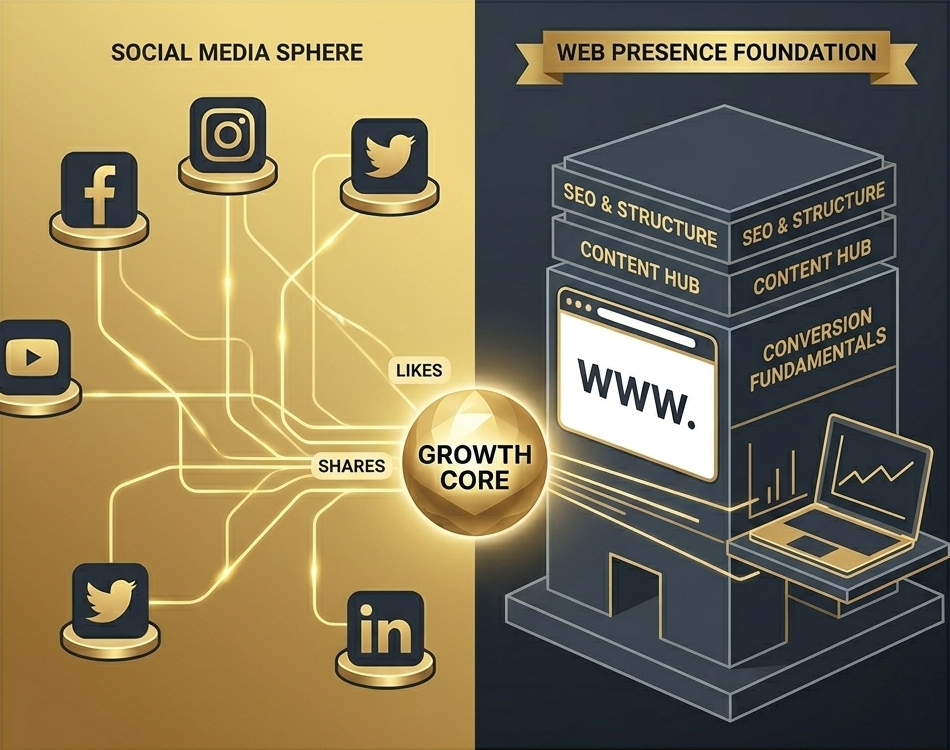
A website is your owned media hub — built for detailed information, product showcases, and conversions. Social media, on the other hand, is rented attention space, ideal for discovery, real-time engagement, and viral moments.
Both have a role. But they are not interchangeable.
Why Your Business Still Needs a Website in 2026
Let’s settle this once and for all. Social media is powerful, but it cannot do everything a website can.
1. You Own Your Audience
When you build an email list or drive traffic through SEO, that audience belongs to you. Your followers on social media are not really yours. The platform can limit your visibility at any time, and you have to pay to consistently reach people who already follow you.
2. Google Cannot Rank Your Instagram Bio
Search engines are where high-intent buyers live. SEO drives 1,000%+ more traffic than organic social media on average. When someone searches “best marketing agency in Guwahati” or “how to grow my brand online,” they are not scrolling Instagram — they are on Google. A website with optimized content puts you in front of them at exactly the right moment.
3. Websites Convert Better
When someone lands on your Instagram profile, they are still in browsing mode. When they visit your website, they are in research mode — actively looking for solutions. That mindset shift makes all the difference for your sales.
4. Credibility Is Non-Negotiable
75% of people decide if a business is trustworthy just by looking at its website. No matter how many followers you have, a polished, professional website signals legitimacy in a way no Instagram grid can replicate.
5. Your Content Has a Longer Shelf Life
Blog articles have a half-life of 1.95 years, while social media content tends to have a much shorter lifespan. A well-written blog post can bring you traffic for years. A viral reel? It fades within days.
Why Social Media Still Matters More Than Ever
Social media is not the enemy of your website — it is its best distributor. Here is what social platforms do brilliantly.
Reach People Who Are Not Looking for You Yet
Social media reaches a broader audience, including those who might not be actively searching for you. As of 2026, there are 5.17 billion social media users worldwide, offering immense potential reach.
Build Real Relationships
Social media allows two-way conversation. You can respond to DMs, run polls, go live, and build a community around your brand personality. This kind of engagement simply cannot be replicated on a static webpage.
Get Instant Feedback
Want to test a new service idea? Post about it. Social media gives you real-time audience reactions that you can use to shape your website content, product offerings, and marketing strategy.
Drive Traffic to Your Website
Social media can tell a compelling story of why people should pay attention to your brand and click through to your website. Think of your social profiles as the storefront window and your website as the store itself.
The Risk of Going Social-Only
This is where many small businesses make a costly mistake. Relying exclusively on social media is a strategy built on sand.
Consider this: a business owner loses her Instagram account of 15,000 followers overnight without warning. Three years of content. Gone. Instagram’s appeal process took two months, and she never received a real explanation for why it happened.
Your website remains as long as you maintain it. In contrast, social media is like renting space in someone else’s building. You can set up shop and decorate your area, but ultimately, the platform owns your presence there.
Platform rules change. Algorithms shift. Accounts get restricted. If your entire business lives on social media, one policy update can erase your reach overnight.
Website vs Social Media: A Side-by-Side Breakdown
| Feature | Website | Social Media |
|---|---|---|
| Ownership | ✅ You own it | ❌ Platform owns it |
| SEO & Google Visibility | ✅ Strong | ❌ Limited |
| Audience Reach | Grows over time | Immediate potential |
| Content Lifespan | Long-term (months/years) | Short-term (hours/days) |
| Credibility & Trust | ✅ High | Moderate |
| Engagement & Interaction | Limited | ✅ Strong |
| Cost to Start | Moderate investment | Free to low cost |
| Conversion Potential | ✅ High | Lower |
| Data Ownership | ✅ Full control | Limited insights |
The Futurist Approach: Use Both, Win More
At Futurists, we believe the website vs social media debate is the wrong question entirely. The real question is: how do you make both work together?
Here is the framework we recommend for brands serious about sustainable growth:
Use social media to attract. Use your website to convert.
- Post consistently on social media to build brand awareness and drive traffic.
- Publish SEO-optimized blog content on your website to capture long-term organic search traffic.
- Use your website to collect emails and build a list you own forever.
- Retarget your website visitors with social media ads for maximum efficiency.
- Link every social bio, every post, and every campaign back to a landing page on your website.
Social media grabs attention and starts conversations. Your website turns that interest into real results — sales, bookings, or sign-ups. One without the other is a missed opportunity.
According to HubSpot’s Digital Marketing Report, businesses that align their website and social media strategy generate significantly higher lead conversion rates than those relying on a single channel alone.
Which Should You Invest In First?
If you are just starting out and forced to choose one, here is a simple rule:
- If you need credibility, leads, and long-term growth → Start with a website.
- If you need fast visibility and community building → Start with social media.
- If you are serious about your brand’s future → Build both, strategically.
Websites provide long-term growth through SEO and lead capture, while social media drives immediate engagement and reach. Together, they create a complete digital presence.
Conclusion: Stop Choosing Sides, Start Building a Strategy
In 2025, the brands that win are not the ones who picked website over social media or vice versa. They are the ones who understood the purpose of each platform and used them as a unified system.
Your website is your headquarters. Your social media is your megaphone. You need both.
At Futurists, we help brands build that complete digital ecosystem — one that attracts, engages, and converts across every channel. Because growth is not about choosing the right platform. It is about building the right strategy.
Ready to stop guessing and start growing?